Data Foundation
How context reaches the model: the source repositories, the ingestion pipeline that makes them searchable, the vector store, and the knowledge graph that maps the relationships between them.
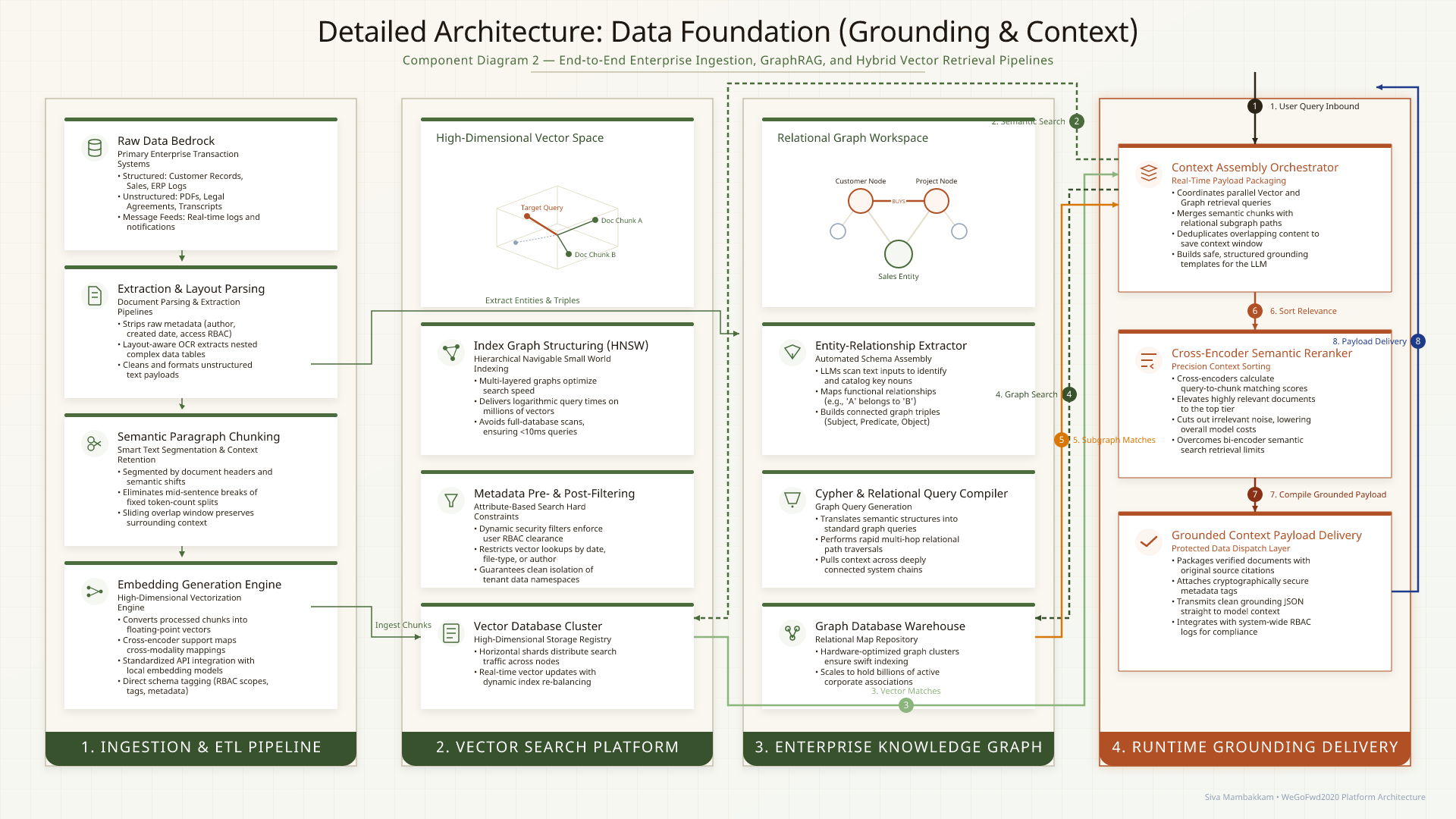
Components
Data Lakes & Warehouses
Grounding is only as good as its sources; fragmented or stale repositories produce confident, wrong answers.
- Structured transaction databases for audited records — balances, order status
- Unstructured document stores for PDFs, contracts, transcripts, and decks
- Consolidated log archives of tickets and history for context
A single, current source of truth for retrieval, so the rest of the pipeline has something solid to stand on.
ETL & Data Pipelines
Raw PDFs dumped into a vector store return fragmented, useless matches.
- Document parsing that keeps text, tables, and layout context intact
- Semantic chunking on meaning rather than a fixed character count
- Metadata tagging — author, department, date — to enable filtered search
Documents turned into retrievable, well-tagged context, and kept fresh as sources change.
Vector Databases
Keyword search matches words, not meaning, and misses documents that say the same thing differently.
- Approximate-nearest-neighbour indexes (HNSW, IVF-PQ) for fast similarity over millions of chunks
- Metadata pre-filtering to scope a search by department or date before ranking
- Retrieval kept inside a tight latency budget so the query pipeline stays responsive
Context retrieved by meaning, which is what decides whether a grounded answer is the right one.
Enterprise Knowledge Graph
Vector search finds isolated passages; multi-hop questions need the relationships between them.
- Entity-relationship mapping across customers, projects, products, and sites
- GraphRAG: combine vector similarity with graph queries for relational context
- Relationship pathways supplied to the model for reasoning over the network
Answers to connected, multi-hop questions that passage retrieval alone can't assemble.