System-Wide Guardrails
The governance that wraps the rest: access control, cost, observability, audit, fairness, and evaluation — grouped into security, safety, and operational telemetry, and applied across every layer.
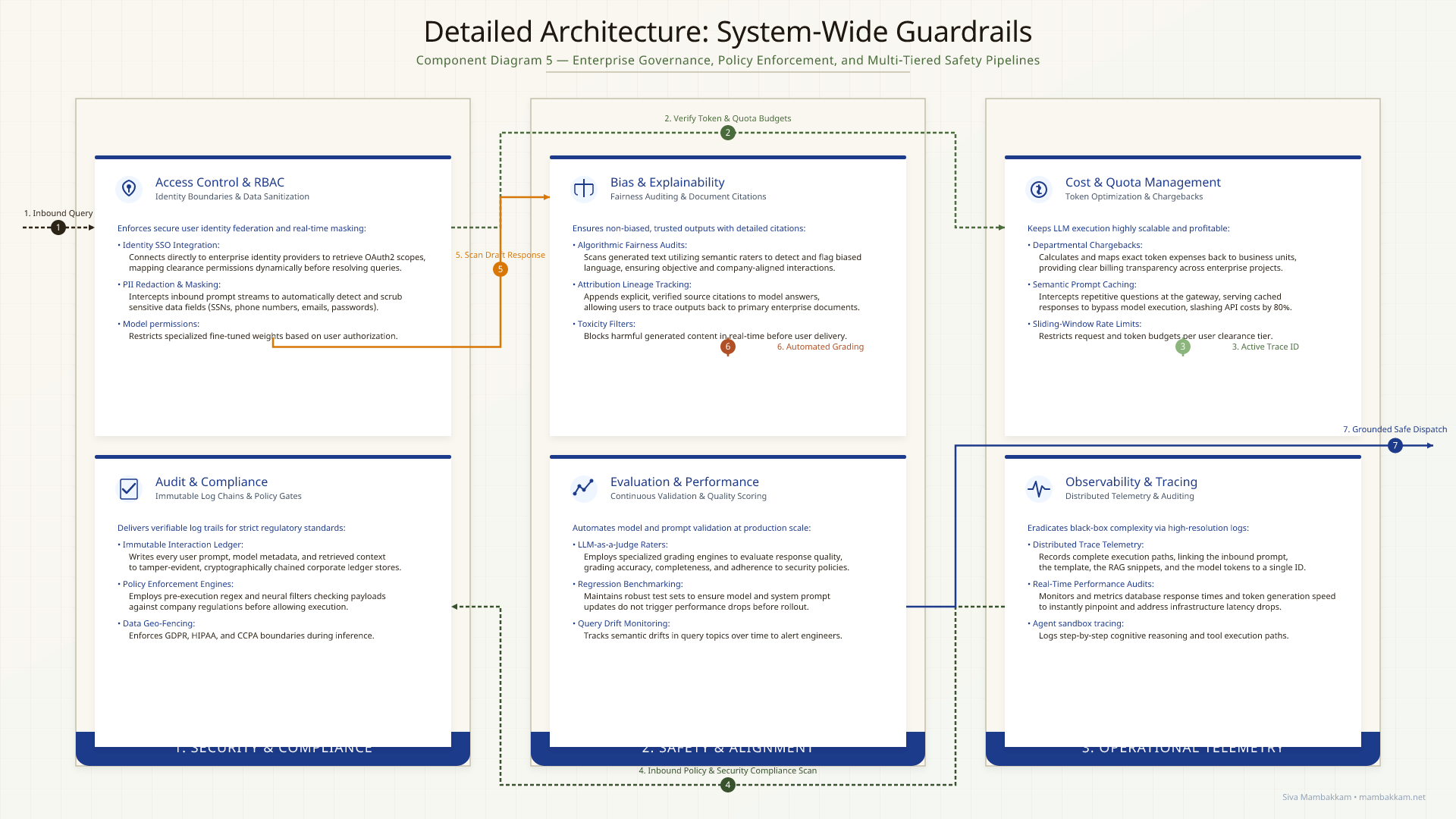
Components
Access Control & RBAC
A model grounded on the whole knowledge base will answer anyone — including an analyst asking for salary or M&A data.
- Identity federation and SSO mapping enterprise permissions onto the request
- PII detection and masking before data leaves the company boundary
- Model-level permissions tied to role and clearance
Grounding constrained to what each user is allowed to see, without slowing the ones who are allowed.
Cost & Quota Management
Token spend creeps; one looping agent or a flood of redundant queries can clear a budget in hours.
- Token budgets per department, team, and role to cap runaways
- Semantic caching that serves a recent similar answer instead of calling the model again
- Chargeback that attributes every call to a cost centre
Spend that stays predictable and attributable, rather than a surprise on the monthly bill.
Observability & Tracing
Output changes every run, so a broken answer is hard to reproduce — was it the prompt, the context, or the model?
- End-to-end traces from query through template, retrieved chunks, response, and guardrails
- Latency broken out by step to find the bottleneck
- Tool-call telemetry to step through an agent's decisions
A non-deterministic system made debuggable, with the whole path visible rather than a black box.
Audit & Compliance
In regulated work you have to prove, months later, exactly what an automated decision did and on what basis.
- Tamper-evident, hash-chained logs of prompts, retrievals, and decisions
- Policy gates that check output against rules before it reaches a user
- Data-residency routing for GDPR, SOC 2, HIPAA, and the like
An audit trail built for an auditor, not a dashboard.
Bias & Explainability
Treated as truth, model output carries real reputational and legal risk — bias, hallucination, toxic content.
- Automated fairness checks over prompts and outputs to flag discriminatory patterns
- Citations back to the source chunks that produced an answer
- Toxicity filtering before anything crosses the user boundary
Decisions you can explain and sources you can point to, which is what trust actually requires.
Evaluation & Performance
A one-line prompt change can improve one feature and quietly break ten; natural-language output resists unit tests.
- LLM-as-judge raters grading quality, completeness, and safety
- Regression benchmarks for factual grounding on every prompt change
- Drift monitoring on the distribution of queries and responses over time
Changes shipped on evidence rather than hope, with regressions caught before users meet them.