Enterprise LLM Platform
The central intelligence layer: the request lifecycle from prompt registry through orchestration to a multi-model hub, with serving and RAG grounding on the path.
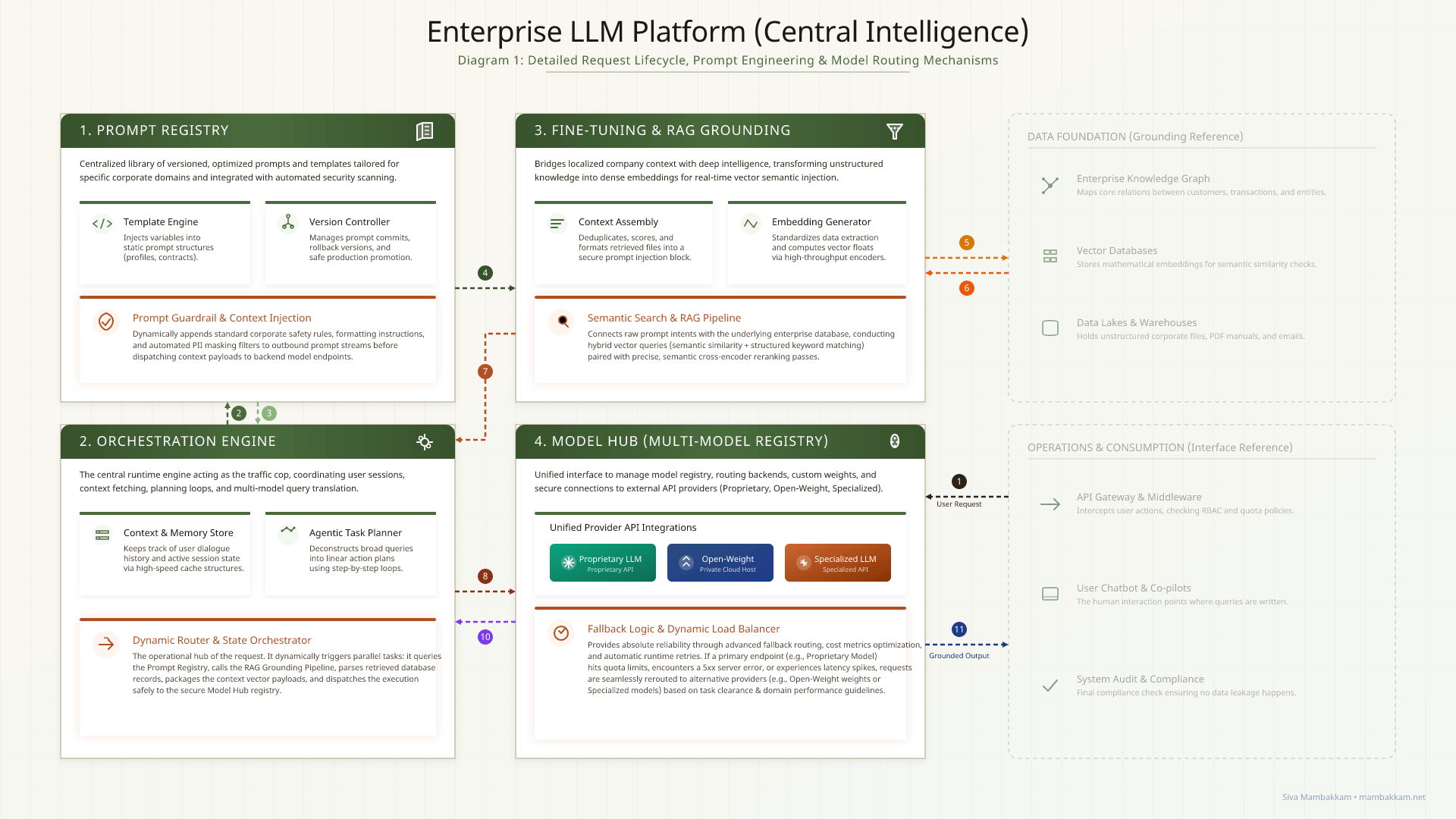
Components
Orchestration Engine
A model on its own generates text; a real task needs planning, memory, tool calls, and state held across turns.
- A context and memory store holding short-term conversation and longer-term semantic context
- Task planners that decompose a request into ordered sub-steps and route each to a suitable model
- Reason-and-act loops that inspect results, recover from errors, and adjust the path
Multi-step work driven to completion rather than a single answer returned and dropped.
Prompt Registry
Prompts hardcoded across application files can't be governed; one edit silently regresses another tool.
- A central template library shared between engineering and the teams who own the wording
- Versioning with git-style rollback, so prompts can be A/B tested and promoted safely
- Input validation on template variables to blunt prompt injection
Prompts managed like the production software they are — versioned, reviewed, and changed without a redeploy.
Model Hub
Wiring applications to one provider is a single point of failure and locks out faster or cheaper models as they appear.
- One API surface that maps across providers, so application code doesn't know which model answered
- Routing by prompt complexity, cost, and availability
- Fallback to an alternative or self-hosted model when a provider degrades
No provider lock-in, and model choice becomes an operational decision rather than a rewrite.
Model Serving & Inference
Running open-weight models in your own infrastructure is where latency and GPU cost quietly get out of hand.
- Inference engines tuned for throughput and token latency
- GPU scaling and tensor parallelism to spread a model across devices
- Quantisation and speculative decoding to cut memory use with little accuracy loss
Custom weights served inside your own boundary at a cost that scales with use rather than against it.
Fine-Tuning & RAG
A foundation model knows nothing of your data; asked about an internal contract, it guesses.
- Semantic context assembly: retrieve, rank, and inject document chunks into the prompt
- Embedding generation that turns corporate data into vectors capturing meaning
- Targeted fine-tuning for domain jargon, formats, and nomenclature
Answers grounded in enterprise sources and traceable back to them, rather than confident invention.